

 Research & Articles
Hanging Gardens of Babylon: A Garden Built for a Homesick Ancient Kurdish Queen
Terminology Intro:
The word “Chaldean” is interchangeable with the term “Babylonian” here because the Neo-Babylonians who took over at the time were the ancestors of the Chaldeans. Assyrian and Chaldean are dialects of the same language, which was mainly Akkadian. Babylonians were ancient Chaldean people, while Assyrians were Northern Mesopotamian. The “Medes” are what historians call Proto-Kurds. They are known as the ancestors of Kurds; therefore, one may suggest that they were ancient Kurds, in the same way that the ancient Greeks are the ancestors of modern Greeks.
The Backstory of the Babylonian (Chaldean) Empire
Nebuchadnezzar II, sometimes known as Nebuchadnezzar the Great, is the most famous Chaldean in history because of his influence as a ruler. The Assyrians ruled right before the Chaldeans at that point. The Assyrians had built their centres of rule in Nineveh and the Levant, developing them into great cities from which they ruled Mesopotamia. The differences in dialect between the Assyrians and Chaldeans slightly divided them culturally, creating a rift in their relationship as communities. Under Assyrian rule, whenever Babylonians (Chaldeans) would rebel, even slightly, in the city of Babylon, Assyria would retaliate in the most brutal and violent ways, burning the city of Babylon to the ground. Besides their powerful rule, the Assyrians had oppressed the people of Mesopotamia for a long time.
During the time of Nebuchadnezzar’s father, Nabopolassar, the Babylonian rebellion was initiated and gradually took over Assyrian rule in Mesopotamia. This led to Babylon becoming the centre of rule in Mesopotamia and ancient Chaldeans ruling Mesopotamia according to their own terms. As Nebuchadnezzar ruled, he built the city of Babylon and was established in history as one of the greatest architectural masterminds. He was known for many factors, such as his rule and conquest of the Levant, initiating the exile of Jews from Jerusalem, and fighting wars with Egypt, going down as a controversial figure in a biblical moral story.
The Divine Union
Nebuchadnezzar’s father had other tribes and communities help him take power and dominate the Assyrians. One of the main groups that rebelled alongside him was led by King Cyaxares of the Medes. King Cyaxares was historically significant for unifying mountain tribes and creating an empire through their unification, strengthening and centralisation. The pact was so deep in trust that King Cyaxares betrothed his daughter, Princess Amytis of the Medes, to Nebuchadnezzar. In its own way, the ancient Chaldeans and ancient Kurds formed an alliance through ancient kings, which gave birth to a government of shared power. It was decided that the Chaldeans would rule Syria, Phoenicia, Palestine, and the southern parts of Mesopotamia, while the Medes would rule the northern parts of Mesopotamia and parts of Anatolia.
The marriage between the Chaldean leader Nebuchadnezzar and the ancient Kurdish princess Amytis was a legendary one because it led to half a century of coexistence and peace between the neighbouring empires in the region. According to later ancient writers, Nebuchadnezzar was in love with the princess and involved her as an active princess who intellectually assisted him in his projects during his 43 years of rule. Although the evidence cannot be found in Nebuchadnezzar’s cuneiform tablets, an ancient Greek priest named Berossus, who had access to Babylon’s official archives, writes about their love 300 years later. This information was lost to time and was only written about later by ancient historians. Princess Amytis was born in Ecbatana, which is underneath modern-day Hamadan, a Kurdish town that sits east of Kermanshah. She was from the Zagros region, which was known for its dramatic mountains, green valleys, and cool air. Her hometown was a place that offered a range of luscious natural landscapes due to winter rainfall and snow. It consisted of scenery where the water that flowed from the melting snow transformed the rich soil into wildflowers and a vicinity of oak trees, creating a nature-bound community.
When Princess Amytis married Nebuchadnezzar, she moved to her husband’s city, Babylon. She felt deep homesickness for her homeland due to the difference in environment. Although Babylon was built directly on the banks of the Euphrates River, she was not used to the extremely hot, dusty, and desert-like nature of the city. She would constantly compare the place to her homeland and fall into depression over it. Babylon was known for its strong desert winds and lack of rain and green nature; its greenery came from certain palm trees or areas close to water. This was the opposite of what Princess Amytis was used to, and Nebuchadnezzar did not want her to return home. After all, this was an alliance-based marriage.
The Construction of the Hanging Gardens
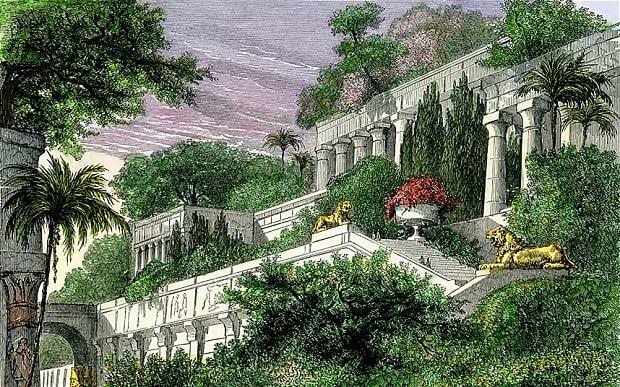
Nebuchadnezzar himself loved the princess and was deeply affected by her homesickness, despite the political side of it. To make her happy, he decided to construct a building resembling a mountain, which is now known as one of the Seven Wonders of the World. This wonder of the ancient world is called the Hanging Gardens of Babylon, and, according to legend, Princess Amytis absolutely loved the construction. According to Greek historians, the Hanging Gardens of Babylon were breathtaking, built on levels of buildings constructed on top of one another, almost like a temple, enriched with soil and different exotic plants that were carefully placed to nourish the microclimate they were meant to achieve, creating a botanical palace. The rocks used to build the structure were rare and were used so that the walls would not rot from the humidity because the building was said to sit near the Euphrates. The Hanging Gardens were detailed and decorated with flowers in a building made from baked clay, embellished with fountains and artificial waterfalls throughout. These stimulated the sunlight to collide with water droplets and form rainbows all over. Although historians have not verified whether the Hanging Gardens were a product of myth or historical fact, the story has been a legend for centuries.
Scholars, painters, and illustrators have reimagined and romanticised the legendary Hanging Gardens in famous paintings, such as those by the German painter Ferdinand Knab in the 19th century. In today’s world, the Hanging Gardens of Babylon have been referred to as a mysterious romantic gesture and a marvel of the olden days, fated to succumb to the fall of empires and time itself.