

 Research & Articles
Quantum Physics: A Science Mystery or Sorcery?
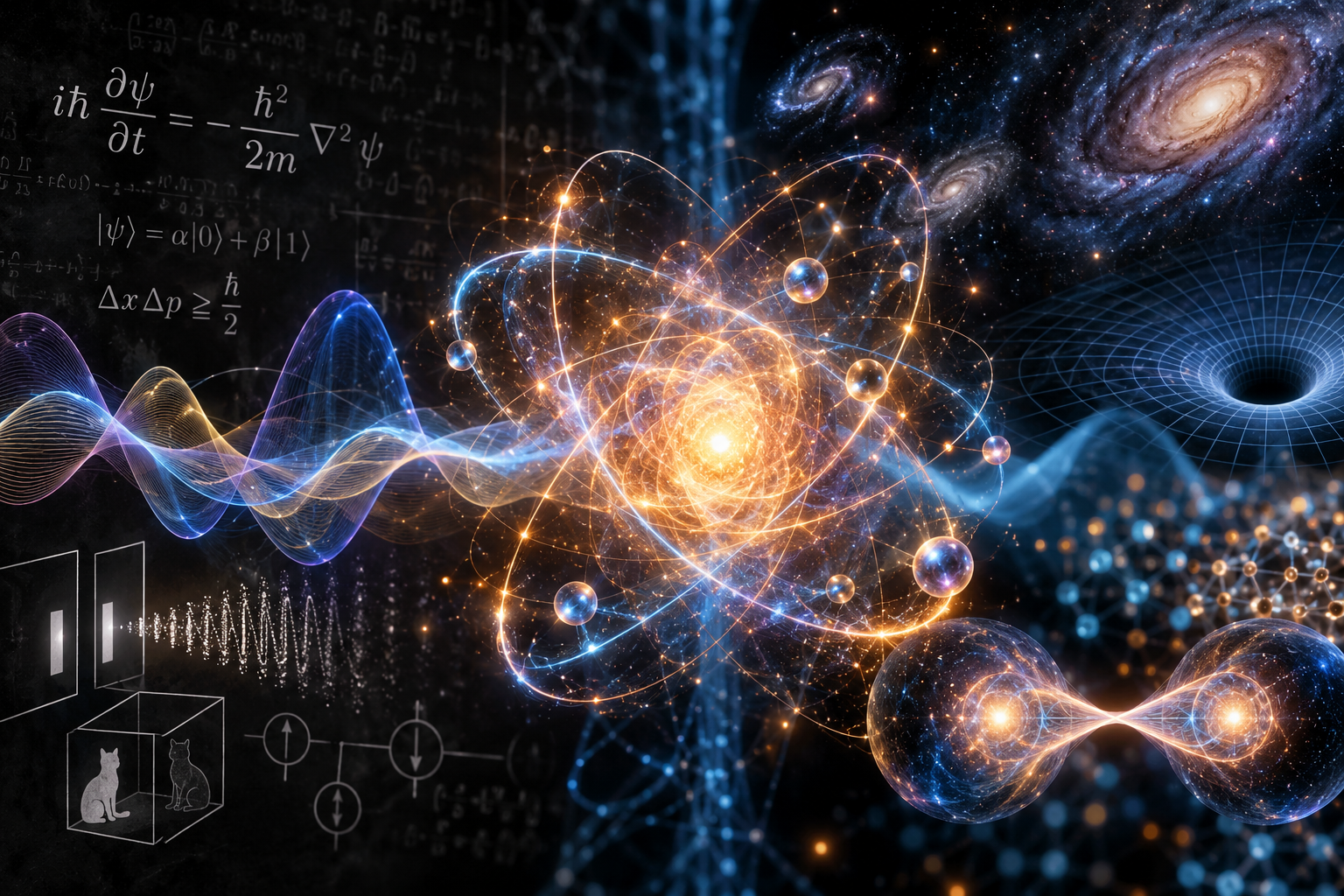
In the 1930’s, Albert Einstein famously said, “Spooky action at a distance,” to refer to Quantum Entanglement. He also said, “God does not play dice,” to which Niels Bohr responded with, “Einstein, stop telling God what to do.” Einstein was so visibly disturbed and frustrated at the idea that Quantum matter acts so mysteriously while no explanation is attained. What is Quantum Physics? Quantum Physics is the physics that explains the behavior of electrons, atoms, molecules and crystals at the smallest of scales.
In 1900, Max Planck introduced Quantum Mechanics by solving black body radiation. His theory was that hot objects emit energy in tiny discrete amounts called quanta. This theory started a new study which scientists started to explore deeply, and it resulted in world changing technology which altered the world as we know it forever.
In 1905, Einstein described the photoelectric effect, a theory that describes light as localized focused energy which are later called photons. In 1924, Louis de Broglie presented his theory regarding wave-particle duality, explaining that electrons actually can behave in waves as well as as particles. In 1925, Max Born, Werner Heisenberg and Pascual Jordan introduced Matrix Mechanics, the first formulation of Quantum Theory.
The timeline concerning the science and study of Quantum Physics started in 1900, and it’s been everflowing since then. To explain how strange Quantum Physics is, a famous thought experiment by Schroedinger is used as an analogy of real life quantum behavior.
Imagine a cat being sealed in a box with radioactive material inside it. The radioactive material has a 50 percent chance of killing the cat or 50 percent chance NOT killing the cat. You would expect the cat to be either dead or alive. However, the cat is described as being dead and alive at the same time, illustrating a phenomenon called superposition, when something is in two states at the same time.
That in itself is strange and sounds unbelievable. Moreover, when one opens the box, the state of the cat shows itself as either dead or alive, as if the state has a life of its own. It shows up as either dead or alive, and it does so when it gets observed, when the quantum system is measured.
Contrary to popular belief, this isn't an actual experiment, it's just an explanation of exactly what particles do when being observed. Cats can not be dead and alive at the same time, and that was Schrodinger's point, to say how is it possible that a particle is at two states and chooses one the moment it gets observed.
Another significant experiment is the two slit experiment, where individual particles of light are sent toward two open slits. One would expect the other side of the slit to have two slits lit on the surface as light passed through those 2 slits only.
In reality, the whole surface gets lit up with different levels of light as more than just two lines. There is a pattern of interference on the whole surface, and it appears that the light has taken both paths through the two slits and interfered with itself, filling the surface with levels of light.
The light has not split into 2 separate particles in reality, but its result looks like it has. The light particle appears as if it took both options at the same time. For example, if you throw a ball at two open doors, it either goes through door A or door B. If the ball was a light particle, it appears as if it goes through both at the same time, which sounds impossible in our physical world.
In this case, it travels in waves, but there is still debate about what this behavior means about the underlying nature of reality. To make things much crazier in the double slit experiment, when a measuring device or camera is placed to detect which slit the light particle passes through, the interference pattern disappears. When a measurement is made, the light particle suddenly passes through the slits to create two lines on the surface as it acts as one particle. Even when it comes to the human eye, the exact same thing happens. The quantum wave function collapses the exact millisecond the photon hits the retina, long before a human brain even knows it happened. It depends on the placement of the eye just like the measurement equipment. The measurement is done in a way where the placement of the measurement tool is placed at the surface of the slit exactly where the photon leaves through the slit. The human eye is also positioned there to have a clear observation of how the photon moves through. The placement of the eye changes the physical setup of the experiment, which completely changes how the photon behaves. The photon suddenly decides to choose one slit instead of acting as waves that intersect through both slits.
How does the light particle seem to change when it is measured? Does it have some sort of consciousness? Why does it change its behavior? All these questions are still unanswered in the scientific realm.
A noteworthy event in the history of Quantum was the Bohr-Einstein debate, which wasn’t an officially planned debate rather than a natural collision of contradictory ideas among two inviting friends who were deeply scientific and intellectual. It did not take place under a specific schedule. It spanned over decades of conversations and arguments which made Einstein and Bohr explore Quantum Physics through disagreement.
It all started in 1927, at the fifth Solvay International Conference, when Einstein attacked Bohr in a presentation, disregarding the timing and setting out mathematical experiments to reject quantum mechanics. Einstein also set out an experiment by imagining a box that releases a tiny particle of light. He believed he could measure the particle's energy and the time of departure with perfect detail, to defy Heisenberg's uncertainty principle.
In 1930, after a sleepless obsessive long night, Bohr found that he could use Einstein's own law of general relativity to show how Heisenberg's principle still works. This was because Heisenberg's uncertainty principle claims that some variables cannot be perfectly known. Bohr used Einstein's law which focuses on time and place. Bohr concluded that the particle is affected by gravity which affects its time of travel, so one cannot know the exact details of the particle's timing or energy perfectly. Due to Bohr's study, Heisenberg's principle of uncertainty still stands true.
Their argument went on and on. Bohr continuously believed that particles behave probabilistically and their nature was simply uncertain, while Einstein believed nothing was random or immeasurable, and there was something hidden behind it.
To give an example on their perspectives, it was as if Bohr would say the sky is blue and it's a fact with its own limits, so just accept it as it is, and Einstein would say there must be a physical reason behind it, it’s not so simple, there is a secret that makes it this way.
Bohr wanted to work with Quantum Mechanics as it was, while Einstein kept questioning its nature. Neither convinced the other in their lifetime. However, they left behind one of Science's most fascinating debates and interactions forever.
It‘s the biggest wonder amongst scientists themselves, yet they make use of it even without understanding its nature. Everyday technology uses quantum mechanics to function. Nowadays, smartphones, computers, fiber-optic communication, MRI scanners and other useful technologies rely on quantum physics.
Nikola Tesla was nothing short of a genius that lit up the whole world with his ideas of modern day electricity. He was a scientist that pre-dated ideas of quantum mechanics, yet he predicted today's scientific developments when he said, “The day science begins to study non physical phenomena, it will make more progress in one decade than in all the previous centuries of its existence.”
He was entirely correct since quantum physics, one of the most mysterious areas of science, is still not fully understood in terms of its deeper nature, yet has made by far the largest most influential changes to exist. The current state of the world started in the mid-20th century, and it is named due to these changes, it’s been named the age of information (also known as the digital age). The age people live in nowadays is named after what quantum physics has contributed to the world which leads to endless information and technology.
Some interpretations and philosophical discussions of Quantum Physics have raised questions about whether consciousness could play a role in how we understand quantum measurement. In that case, from a philosophical perspective, one can suggest that the universe is somewhat conscious.
Some suggest that the discovery of quantum physics and the unfathomable behavior of particles can be interpreted as philosophical evidence for God's existence. Although science doesn’t make claims about the unknown, some philosophers have interpreted Quantum physics as metaphysical evidence that a collective consciousness exists which is synonymous with the universe and God.
The concept of an unexplainable science which links consciousness and mass awareness from things that are not necessarily alive has made spiritualists or philosophical fanatics believe that everything is interconnected and the universe itself acts as a being or is controlled by a bigger power.