

 Research & Articles
My Fascination with Ernesto Che Guevara
My Initial Intrigue
When I was 16, I was looking for a film that had beautiful scenery and aesthetically pleasing shots I could enjoy, something that could feed my wanderlust imagination at the time. I came across a film called the Motorcycle Diaries. It was filled with gorgeous scenes of natural views from the exotic lands of South America. The scenery in Peru, Chile, and Colombia is not something you see every day on television. I saw scenes of virgin lands, featuring nature out of this world yet very much of the earth, untouched, incorruptible, and far away.
My recollection tells me the film started with two adult men deciding to take a sort of gap year to travel the world while they were young and eagerly charged about the beauty of the world. Their families seemed concerned yet trusting as they were setting off on their journey. One of them was taking a gap year from medical school. They were young, energetic, one of them becoming a 24-year-old doctor with not much left to fulfill his degree, the other a 29-year-old biochemist who wanted a wild adventure before settling into the societal norm. They were so insistent on getting on with their worldly endeavours first and finishing everyday life matters second.
What’s crazier is that this was not any form of travel, it was travel on nothing but two motorcycles. Two dreamy-headed, curious, educated men from prestigious families taking on dangerous roads with nothing guaranteed and everything at stake. They were off to the smooth and bumpy roads of South America alike. On this questionable adventure, they expected one thing, which was to see a special part of the world. What they actually saw, besides the expected mysterious beauty and exotica, was the chaos, ruin, and human despair that existed along the way. It especially influenced one of the men so deeply, as the adventure turned into a kind of spiritual disturbance, where he deeply questioned the world and himself all at once.
The man who was soon to become a doctor was called “Fuser.” Fuser was emotionally moved when he heard the poor communities of different towns complain. When he saw them firsthand and witnessed all their suffering, he could not bear that helpless feeling. You could witness him getting shaken by a feeling of emptiness, a void, which, if he had ignored it, would consume him. It was as if the safety of the world was in the palm of his hands, that the world was crumbling right before him and he couldn’t do a thing. The sights he saw he treated like daggers wounding his humanity, the indigenous people of a land being dismissed and torn from shelter, the economies of valuable communities being broken and leaving people stranded, triggering his highest sense of compassion, while he discovered a new world within himself on this particular trip.
The ending of the film was a simple one. This man, Fuser, struggled with asthma regularly. He shocked the audience when he decided to jump into a lake of freezing water, gasping for air, which made the watcher feel concerned and uncomfortable for him. His friend yelled out his name, yet Fuser was in his own world, ecstatic from the way he tried to survive the lake, like some addictive pain he was seeking out.
Looking back at the scene, I’ve interpreted it to be something different. He was a potential doctor with education, friends, love, women, and journeys like this on his mind. He washed his ordinary self off entirely to replace himself with someone who had nothing in his head but the abandoned state of the world as the core reason for everything he did, a savior, someone who acted and refused to watch.
The bathing scene made me ponder: Was this a rebirth, perhaps? A symbolic baptism where someone completely new was born or had he simply washed himself of all the superficial to reach his pure essence? Was the fight against drowning a rebellion against the existence of all that is absurd and painful in the world? It could have been a way of proving his fearlessness to himself facing death, while coughing so desperately for air, after throwing himself like a madman.
I was moved when I saw everything from his point of view, overwhelmed by emotion, even when his friend thought him to be overly dramatic at times and focused on the worst. I understood Fuser’s passion. I gasped and was shocked, feeling like I hadn’t paid enough attention when the ending said Fuser then went on to become Che Guevara, the great revolutionary. The Motorcycle Diaries set the basis of Guevara’s political path! It immediately instilled in me great admiration and respect for this larger-than-life personality who left everything behind for his dreams of this world. The Motorcycle Diaries were apparently his true biographical, real-life writings about that experience. The film adaptation was brilliant. He was so human in those moments that I saw him as an intelligent yet simple character. I couldn’t believe it was meant to be him since the name was entirely different, and so was the state of him.
Guevara’s Legacy
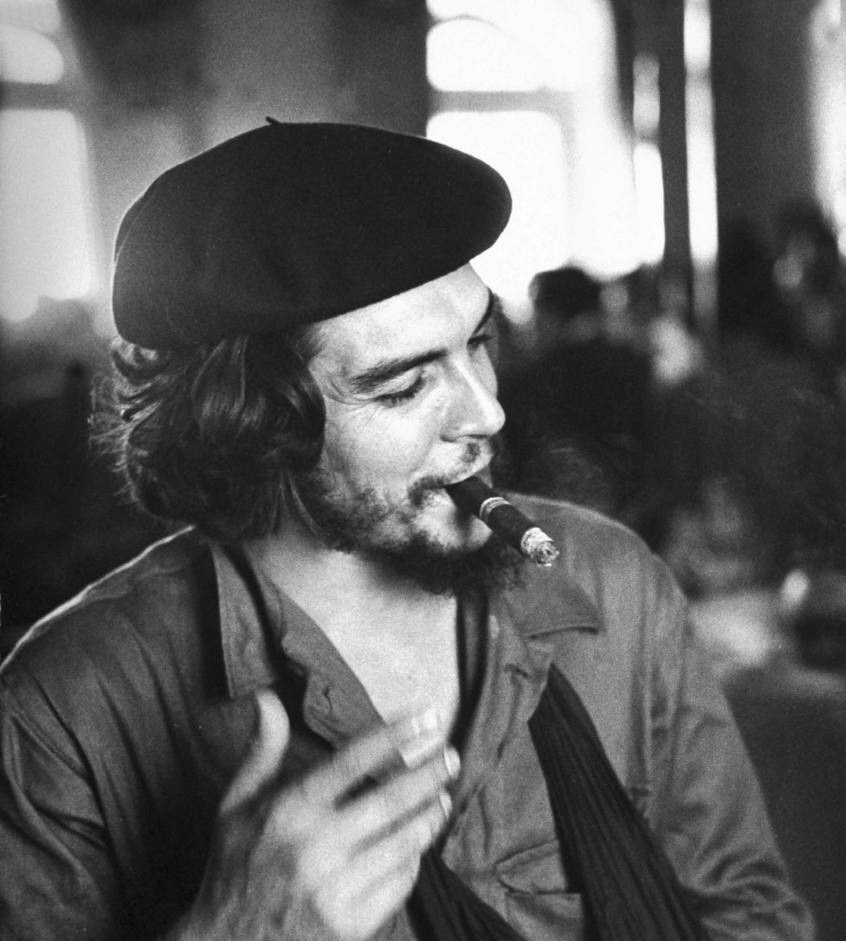
Guevara’s fame as a revolutionary echoed beyond imagination. His undeniable charisma and charm were difficult to overlook because he possessed good looks, exuded masculinity in uniform, and smoked cigars in political settings. It was no wonder that his face became something iconic and symbolic across the world. I’ve probably learned of him through those photos, immediately feeling a political spirit that made me question the origin of that stamped photo everywhere. Funny enough, I would always recognize his face on the backs of regular trucks in Kurdistan, and even taxis sometimes.
When I read about his political activism, his goal was simple, to demolish the power which he believed the United States carried over them. To sacrifice his dreams for the sake of a better world, at least a world he believed in, was his main ambition. He believed Imperialism and Capitalism to be the root of all that was wrong with South America. He emphasized the strain it had on society and how it cast extreme poverty. He helped lead the revolution with Fidel Castro to overthrow the government in Cuba. While he himself was from Argentina, he decided Latin America shared a common enemy so he involved himself with Cuba due to the political tension with the US at the time. He chose to adopt a communist movement as the sole solution for the state of Cuba because he thought it was the only way to dismantle the injustice imposed on the poor. Although he was a Marxist, he was suspicious of the USSR and thought of Russia as another Imperialist state to which he opposed.
There is much debate about whether his beliefs make him a good person or a vicious one. He himself had admitted that sacrifices needed to be made, and that meant people had to suffer and die in order to take out a bigger evil. He was known for being too brutal with political prisoners, ordering mass executions without the judiciary. He famously said, “To send men to the firing squad, judicial proof is unnecessary. These procedures are an archaic bourgeois detail. This is a revolution! And a revolutionary must become a cold killing machine motivated by pure hate.” He ordered executions without trials. He also set labor camps where people were subjected to forced labor and political ideologies. Some believe his behavior was inevitable given his sudden rise to great authority.
When emotions are too high and someone is so passionate about something, it can be blinding, and the person may lose themselves to those emotions. As Nietzsche once said, “He who fights with monsters might take care lest he thereby become a monster. And if you gaze for long into an abyss, the abyss gazes also into you.”
I sometimes think he looked far into the abyss, yet it might sound like I’m making excuses for inexcusable behaviour. I don’t condone violence and have learned to hate the sin rather than the sinner. He was indeed a complex character who confuses us in terms of a politically correct revolution and everything he stood for. The psychology behind the duality of this man makes you wonder if he was one or the other entirely.
Humanity is complex, and he was the perfect epitome of what it means to be a human. He embodied the coexistence of the softest, most tender side of human nature with a hardened, almost primal self. These sides did not necessarily balance one another, rather they existed in opposition, facing each other as two activated dimensions of the same being. Much like the civilized self and the natural animal within man, the latter reaching back to our most primitive foundations, to the cave dweller, the primordial human, the creature we were at the dawn of time.
He was not chaotic or inconsistent as he was true to his goal. It was this devotion that made him stone cold at times. In his perception the drive he had for achieving what he gave up his whole world for, was far bigger than anything, anyone, and even himself. Yet I do not take his violent actions lightly, he caused people direct and indirect pain. These contradictions have made him a controversial figure, an irrational one, who is ironically like the enemy he so passionately diverts from.
My lasting impression
I remember my sister asked me what I found so fascinating about Che Guevara, and I said I think he is the truest form of a human, the most whole human being I have ever heard of. I later read that the great philosopher Jean-Paul Sartre said something very similar, which made me feel validated. He said:
“You know how much I admire Che Guevara. In fact, I believe that the man was not only an intellectual but also the most complete human being of our age: as a fighter and as a man, as a theoretician who was able to further the cause of revolution by drawing his theories from his personal experience in battle.”
We might have said something similar about Che Guevara, but for different reasons, as Sartre spoke of existentialism and his philosophical framework.
I simply meant that Che Guevara, given how extreme the path he took in his life was, really dwelled through his own inner duality. I found him to be a somewhat balanced person for someone who was so extreme. He was self contradictory at times, yet always himself, he did not mislead about his actions or the justification for them. The contradiction came from the character I saw as kind and obligated to save humanity’s pain, turning into the person who dared to inflict pain on others for his means to an end, even if those ends were to redeem himself and the world. Guevara’s father mentioned that his son’s character was a product of his Irish heritage and that he had Irish rebellion flow through his veins. On the contrary, some perceive him as a rebel without a cause because he only influenced Cuba through his movement under unethical circumstances.
He was deeply affected by the injustice he saw, and one of the things that further moved me about him was when his daughter, Aleida Guevara, stated, “If my father was alive today, he would have been fighting for the Kurds.” I do believe he was a freedom fighter, one who gave up a secure job and a lavish life for a life where he chose, in his own words, “Patria o Muerte,” meaning “Fatherland or Death,” as he walked up to the UN podium looking armed in his olive greenish military uniform and combat boots. The black-and-white video still emits colours and a force inexplicable to man.